
This time during lockdown can be especially challenging. We are not only dealing with the pressures of working from home while home-schooling or caring for our little ones full-time, but also with the health and economic worries. While we are with our younglings 24/7 over the next couple of weeks, let’s explore and change some unhelpful parenting habits.
Parenting as it stands
We’ve been parenting the same way for decades. Why do we need to change? What is wrong with the way that we are parenting?
These are just a few of the questions that tend to come up when I speak with parents about changing some of their parenting habits. What is wrong with the way that we parent?
Past (and mostly current) parenting strategies include some or all of the following:
- Inductive reasoning
- Verbal threats
- Restrictiveness or firm control, sometimes including harsh or punitive actions
Now, to consider how these strategies play out in our daily lives, let’s look at the following example:
Johnny, aged 4, is emptying out his entire toy box in the living room, just after Mom cleaned up. Mom says, “please put the toys away, we are having dinner soon.” As often happens with our spritely younglings, Mom is ignored, and Johnny continues emptying out his toy box. Mom is a good mom and doesn’t want to resort to yelling and arguing, so she takes a deep breath and says “Johnny, someone might trip over your toys. We don’t want that to happen, do we?” Johnny, a good boy, agrees that he doesn’t want anyone to trip over the toys. Mom is satisfied that her message has come through and walks away, thinking that Johnny will soon start packing up the toys strewn all over the living room floor. A few minutes later, she returns only to find that Johnny is still emptying the toy box systematically. Frustrated, she yells “Didn’t I tell you to pick up the toys?! If these toys aren’t put away when I get back, I am going to throw them all away!” Johnny looks up at mom, lip trembling, and nods. Mom walks away, feeling terrible about yelling, but also a little satisfied that she has been heard and that the toys will be put away. When she comes back again, some toys have been cleaned up, but the majority are still on the living room floor. She rushes in, yanks Johnny up by the arm and puts him in time-out. She walks away, berating herself for being ineffective in getting Johnny to listen to her, feeling just awful about her reaction and having yanked him up quite harshly. She hears Johnny crying in time-out.

So, what happened here? Let’s break it down for a sec:
- Mom is tired but felt good about having the living room tidied before dinner
- She starts feeling a little niggle of frustration as Johnny is messing up her hard work, but is proud that she didn’t let this get the better of her and that Johnny responded to her attempt to reason with him (inductive reasoning)
- The little niggle of frustration grows, and she feels like she is being ignored by Johnny when he still doesn’t pick up his toys. She loses it, yelling and threatening to throw away his toys (verbal threats)
- When the verbal threat is only somewhat effective, Mom reaches the end of her tether and grabs him in frustration, pulling him to what she views is her last resort, time-out (firm control, punitive action)
Now, by this time, no one is happy and both Mom and Johnny feel terrible. It is unlikely, however, that this will be the last time that this happens, and we can start seeing this cycle develop:
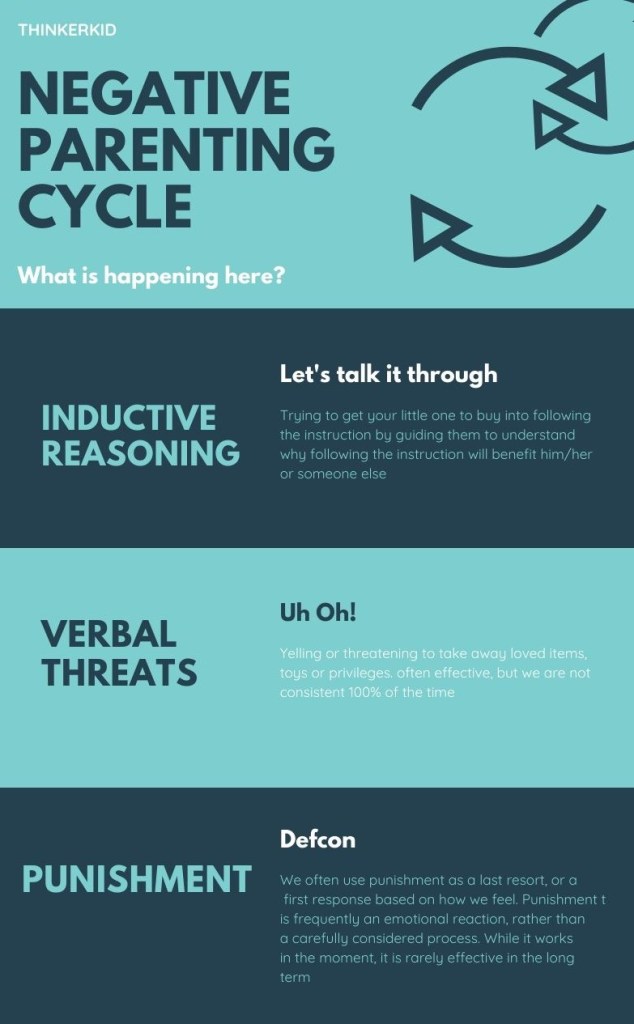
But mom is a good mom, and doesn’t want to start with punishment each time, so she cycles through the tools at her disposal, more often than not ending up by punishing Johnny. Her and Johnny’s relationship doesn’t really improve and by the age of 14, Mom barely knows what is happening in his life. Granted, this is quite the leap, but in most cases, this is what happens when punishment is over-used.
Think back to some of the strategies that your own parents used. Unless, by some miracle, your parents were forward-thinking, highly enlightened beings, you probably did not always feel heard, appreciated and loved, much less so when being disciplined.
We are human beings.
That phrase encompasses all that happened here. When we, as human beings, feel unheard an emotional response is triggered. Naturally, we entertain this emotional response and engage with it. The more we engage with this emotional response, the harder it is to downregulate and approach the problem with compassion.
If any of this sounds familiar, keep reading!
As parents, we feel that it is our job to be fully in control of our children’s behavior. Unwanted behavior is thus imbued with our judgement of ourselves as parents and we berate ourselves for not being able to control our children. In the community at large, this thought pattern is strengthened by other adults around us, wanting to either jump in and help us control the behavior, or making snide comments about our perceived inability to parent. And what mom wants to feel like a bad mother? We bring all of these feelings to our relationship with our child.
So, what do we do?
First, we need to become aware of these thoughts about our parenting skills, and our thoughts about these thoughts. Only when we are aware of what is triggering our reaction in the moment, can we really buckle down and change it. Becoming aware of these thoughts and feelings help us to navigate the parenting relationship in a more honest and open way. Don’t judge yourself for having these thoughts and feelings – remember, you are human with a long history of conditioning in terms of what it means to be a good parent.
Second, we need to take our children’s thoughts, needs and wants into account. Parenting is a two-way relationship, and it is crucial to keep in mind that our little ones are part of this relationship. When we parent from the control perspective, we are likely parenting in a way that serves us, and not our child or the relationship. Our actions are then motivated by decreasing our own stress, increasing our own pleasure, habituated responding (or responding on autopilot), or parenting from the perspective of “being the one in control”. This last one is a doozie, as it is directly opposed to developing a warm, trusting relationship with your little one. Parents who are able to be attentive and aware of their little ones’ needs, thoughts and emotions are able to create a family environment in which warm, loving interactions are sustained, and more satisfaction within the parent-child relationship is cultivated. And who wouldn’t want that?
When parents cultivate mindfulness in their interactions with their children, they are better able to parent in a calm, responsive and consistent manner that is in line with their values and goals as parents. This fosters a warm and nurturing environment in the parent-child relationship that allows trust and respect to develop.
Okay, what does mindful parenting look like?
Parenting mindfully does not mean that you will not experience negative emotions, such as frustration or anger. It also does not mean that you will accept inappropriate behavior from your child. What it does mean, however, is that you will take a moment to pause and reflect on your thoughts and feelings about what is happening in that moment, and choose the response that is congruent with your values and beliefs as a parent. There is power in the pause!
While it is easy to think that mindfulness is only for situations in which discipline is needed, we cultivate these habits and principles during the positive interactions. When things are going well is when we want to practice being mindful and intentional in our interactions. During these times, it is easy and natural and thus, it is the ideal time to make mindfulness a habit.
Below are the basic tenets of mindful parenting, and we will explore these tenets in-depth through subsequent blog posts:
- Attention and awareness to thoughts, feelings and external factors during parent-child interactions
- Acceptance, without judgement of your own and your child’s thoughts, feelings and external reality
- Acting with emotional awareness
- Thoughtful responding during parent-child interactions
Daily practice: Give yourself some points each time that you become aware of and accept the situation without judgement today.
Resources:
As a coach, consultant and practitioner, I strive to ensure that all the help and advice that I give to parents, children and young adults is backed by research. Below are some helpful articles that were referenced in this post:
Duncan, L. G. (2007). Assessment of mindful parenting among parents of early adolescents: Development and validation of the Interpersonal Mindfulness in Parenting scale.
Duncan, L. G., Coatsworth, J. D., & Greenberg, M. T. (2009). A model of mindful parenting: Implications for parent–child relationships and prevention research. Clinical child and family psychology review, 12(3), 255-270.
Raulston, T. (2018). Effects of the Practiced Routines Parent Training Program on Behavioral Strategy Use, Parental Well-Being, and Child Challenging Behavior in Parents of Children with Autism Spectrum Disorder.

 ThinkerBlog