
We could all use a little more consideration and acceptance, right? There is nothing like being truly seen and heard to make us feel valued. Today’s post is about how you can use awareness and acceptance to see and value yourself and your little one in your quest to become more mindful.
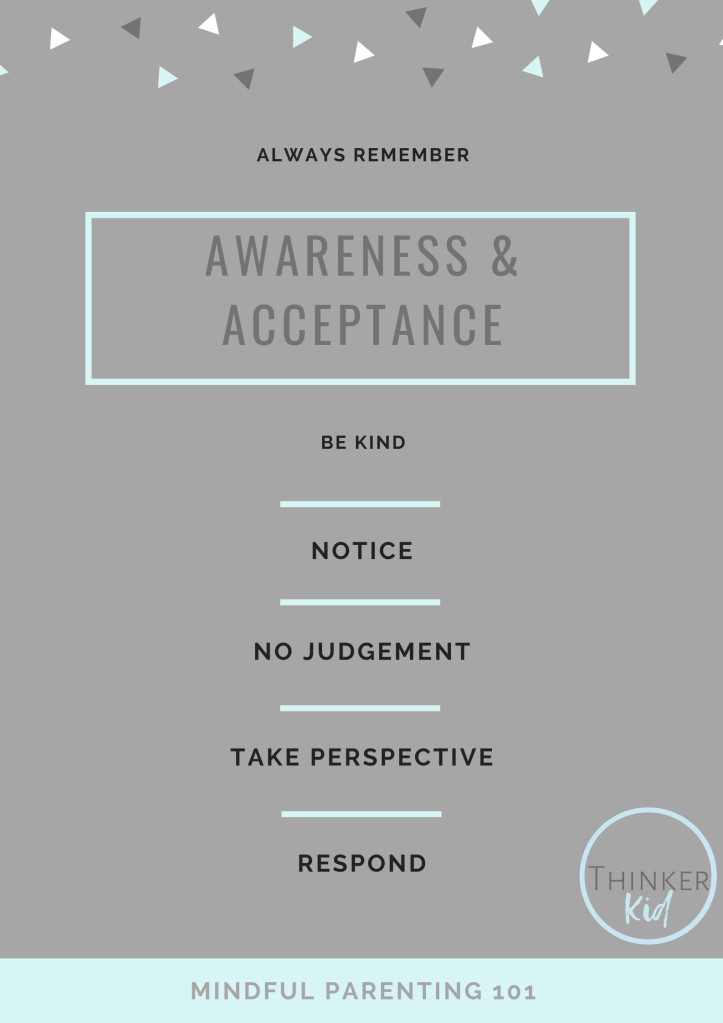
Awareness in the moment
While a situation that you might consider to be unwanted or negative occurs, take a minute to step back and observe before you respond to it. I promise, not reacting right away does not show your child that the behavior is okay. We are just taking a moment to really connect with ourselves and our experience of the moment.
When you step back, notice your thoughts about what is happening. Are they positive, or negative? Are they about the situation or about your little one? Just notice your thinking in the moment. What language are you using? Language is how we relate and frame our experiences – we use language to make meaning. What meaning are you making when you think about the situation? It is okay if they are all negative, or some positive, some negative. They are what they are.
Now, notice the interplay between your thoughts and feelings. How do you feel in the moment? Are your thoughts influencing your emotions? Are your emotions influencing your thoughts? Notice this.
A lot of our frustration and anger when dealing with a difficult situation stems from our desire to avoid or escape these thoughts and sensations. No one wants to be dealing with a 20-minute tantrum – it’s safe to say that every one of us are fairly motivated to put an end to the tantrum as quickly as possible. Notice this desire too.
By taking the time to notice our thoughts and feelings in the moment, we create a space in our minds that allows us to separate these thoughts and feelings from our rational selves. Just like Schrodinger’s cat, the observation itself allows us to gain power over these thoughts and feelings, rather than us being controlled by them. Noticing, and noticing that we are noticing gives us a little more space internally to consider how we want to respond. When we allow our thoughts and emotions to control us, we more often than not react to our little ones in ways that might not be in line with who we want ourselves to be for our children. We might react out of frustration and anger, becoming more aggressive than necessary.
Accepting Ourselves and the Situation
It is important here to acknowledge again, that our aim with observing these thoughts and feelings is not to judge them. We are human, and these thoughts and feelings are natural responses to aversive situations. They simply are what they are. This is acceptance. It does not mean that we are happy with the situation or think that it is okay. Acceptance does not mean that we condone the behavior from our little ones. The purpose behind accepting our thoughts and feelings is to acknowledge them, and to release their hold over us. When we do not allow our thoughts and feelings to control our behavior, we have the space and the freedom to respond to our little ones in a way that is in line with the values that we hold as nurturers, protectors and guides of our littlies.
When we become aware of our thoughts and feelings, and accept them as they are, it also gives us a moment to consider the thoughts and feelings of our children. Taking their perspective in these situations further helps us to step back and consider the situation more objectively.
Awareness and Acceptance with Our Littlies
In our example from last week, Johnny is emptying his toybox onto the living room floor and does not listen to Mom’s requests for him to tidy up. Let’s take his perspective into account – here are some things that Johnny might be thinking and feeling as he digs through the toy box, although he may not have the language to voice it to his mom:
- “Billy said something that made me sad and embarrassed. I didn’t like it. Scratching through this box and seeing and touching all my toys makes me feel better, safe.”
- “I had such a full day of people telling me what to do all the time. I’m tired. I need a few moments with my toys.”
- “I’m not ready to stop playing. I’m enjoying this, and I know that after dinner it will be bath time and bedtime. If I don’t respond, I might get a few more minutes to enjoy myself.”
- Perhaps, Johnny didn’t even hear mom the first time. Perhaps he has trouble shifting his attention, or stopping one action and initiating another.
When we look at the possible things that might be going through Johnny’s mind, it is hard not to feel a little empathy for this little guy. More often than not, our littlies have all these thoughts and feelings that we fail to consider, and they simply might not yet have the vocabulary to express them to us in order to get their needs met. And because they can’t express it, it is all too easy to take their behavior personally. It is, thus, all the more important to be aware of these things and how they mediate our littlies’ behaviour.
Our little ones often simply haven’t had the time to develop skill sets such as logical reasoning, emotional regulation and shifting attention; to respond as we would prefer them to. It is not fair to expect them to behave in a certain way if they don’t have that skill. We should therefore strive to accept their behaviour in the present moment as a skill deficit, rather than a personal affront.
When we step back and observe the situation as it unfolds, gaining that present moment awareness, and stepping out of the chatter of our own minds, it is easier to consider our little ones’ perspective and respond (not react) in a way that may help them get their needs met, and help us to a) parent in alignment with our values, and b) get our needs met as well. Now that you are aware and attentive to what might be going on, don’t react. Respond to the situation in a way that reflects the relationship you would like to have with your child, and in line with the values you hold as a parent.

Take home points:
- Notice your thoughts and how they influence your emotions during a difficult interaction
- Don’t judge yourself or the situation – it is what it is
- Try to consider the situation from your little ones’ perspective
- Take nothing personally
- Choose a response that is in line with your values
Daily Challenge: Take a moment during positive interactions to take your little one’s perspective. What might they be thinking and feeling in the present moment?

 ThinkerBlog