

We have all been there – from trying to reign in our frustration when a tantrum erupts, to feeling powerless but responsible when our toddlers are just struggling to manage their feelings. Even simple everyday activities, like the morning rush (where the solution is so clear “just move faster!”) but our toddlers just can’t seem to do it. It’s no wonder that frustration comes up as one of the first things that parents want to work on when they first come to me for coaching.
The first thing I want to tell you as a parent is this: It is normal. Feeling frustration is part of the human experience. Feeling frustrated does not mean you are a bad parent. It just means that you are in a situation that you find challenging. Even as a parent coach, I feel frustrated sometimes.
One of my most vivid memories of feeling frustrated with a little one was running a therapy session with a little guy of about 5 years old. He was the most adorable little boy, but that day both he and I had the worst time. He wasn’t interested in anything I tried to get him involved with, and it bugged me. I was so upset with myself for letting my frustration get the better of me once I realized what was happening. And then I realized the most important thing – I am not a robot. Of course I got frustrated! Just allowing myself the release from this sense that I was not allowed to become frustrated was such a relief. And that’s when it dawned on me:
My frustration was all about me.
This gorgeous little boy was just telling me that he wasn’t interested. And the more I reacted to my frustration, the more I pushed. And the more he pushed back.
When I took a step back, and allowed the frustration to just be, instead of trying to avoid or fix it, the more clearly I could see what he needed. In that moment, he didn’t need to be offered or enticed into doing anything. He was just happy sitting with me. When I responded to that need, the entire session turned around (for the most part, anyway).
This is so true of what we go through as parents. Frustration tends to creep up on us when we feel pressured to fix or resolve whatever is going on. Crying? Oh, I must have done something wrong, I better make it right. Moving too slowly and making us late for school? Shoot, the teacher is going to be upset and I will have to explain what happened.
And the more frustrated we feel, the harder we try to push against it, not realizing that frustration isn’t a wall. It’s quicksand.
Five ways to manage frustration:
- Awareness and acceptance
This isn’t easy, but when we catch ourselves and take a second to think “what is happening here?” we are able to identify the trigger. Notice your thoughts about what is going on as well, and find the trigger, for example: “I don’t know why she’s just sobbing all of a sudden. I need to make her feel better now!”
Once you know what your thinking mind is saying, instead of trying to push away the thought or feeling, accept it. Tell yourself “I hear you. It’s a lot of pressure. It’s okay.” Acknowledging and accepting the feeling is analogous to stopping thrashing about in the quicksand. The less you try to escape from it, the less likely you are to go down.
Bolte Taylor suggested that biologically, there is a 90 second window in which the brain and the body processes the chemicals that come from a particular emotion, whether it be anger, sadness or frustration. After those 90 seconds, “any remaining emotional response is just the person choosing to stay in that emotional loop.”
This goes for both you and your child. We inadvertently choose to stay in that loop when we try to avoid or resist the emotion.
- Step back from being an emotional “fixer”
Much of our frustration as parents comes from the need to feel in control and able to “fix” our childrens’ problems. When they are little and crying, and we do just about everything to identify what the cause is. As they get older, we shift some of this responsibility to our children, but then feel frustrated when the behaviour doesn’t seem to change. This stems from the belief that we need to “fix” or “solve” every problem we encounter. A much more useful endeavor is to coach our children through difficult emotions. This can be either co-regulating with them, or talking them through self-regulation.
Unless your child’s health or safety is at immediate risk, rather than focusing your energy on finding a solution, focus on coaching your little one through their own emotions. This can sound like “You’re really upset right now. You didn’t like that the plans changed.” By coaching our little ones through their feelings, we take the pressure off of us needing to fix it. Instead, we teach our little ones how to respond to their own emotions in a healthy way. By always trying to find a solution, we inadvertently teach our children that some emotions are not okay and we shouldn’t have them. Kind of like how we respond to our own frustration – by trying to fix it quickly. When we understand that emotions are not good or bad, they simply are, frustration begins to lose its hold. It is no longer a threat to us.
- Pause
One of my favorite quotes from a recent podcast recording is this:
The work happens in the pause.
When we pause to reflect on our emotions, the relationship and what is happening, it opens up a space for us to choose how to respond – instead of react – to the situation. This is where mindfulness practice becomes really helpful. Those few minutes we practice by ourselves each day makes it easier in the moment to create some cognitive space and to step back mentally to assess and address.
- Remind yourself …
“I’m okay, you’re okay, we’re okay.” When little ones direct their big emotions at us, it is hard not to take it personally or move into the space of needing to “fix”, especially when we don’t know where the behaviour is coming from. By repeating to yourself that you are okay, in the relationship sense, we remind ourselves that we love this little human, and this little human loves us, and this will make it okay. Resting in the knowledge that the relationship itself is okay reduces our urge to fix or withdraw in order to avoid the uncomfortable feeling.
- Have a growth mindset
(you can read my article on Growth Mindset here)
None of us where handed a manual along with our newborn. This is hard. And its hard for everyone. When we become frustrated, we can choose to see it as a fixed trait and then integrate that into our identity, but truthfully, that’s not going to help anyone. When we choose to be open to the experience and learn from it what we can, we are demonstrating the very skills we want our kids to learn. Being able to accept that we made a mistake and turn it into a learning opportunity takes a great amount of self-awareness and humility, but the juice is worth the squeeze ten-fold. It might look a little different for everyone, but it can sound like “wow, I didn’t realise that was a trigger for me. Next time, I’m going to …”
It’s okay to mess up, it’s inevitable that you will. But its better to learn from each experience and focus on doing better.
Pro-tip: Is your emotional bucket full? It is much harder to stay calm and have saint-like patience when our little ones need us to if our own emotional resources are stretched to the max. Self-care is not a luxury, it’s a necessity. We cannot provide a safe emotional space for our little ones without making sure that we have that space for ourselves.
Helpful Resources:
The books below have been invaluable to me on my journey to learning how to manage my frustration and get the best out of my clients. I hope they are helpful to you too!


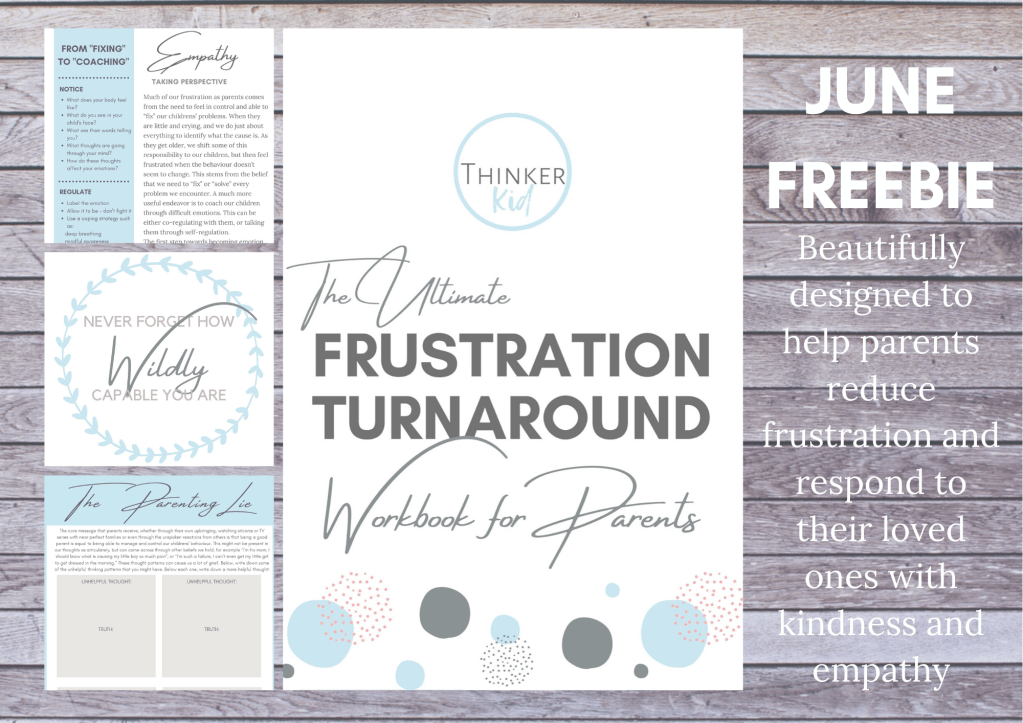
Alternatively, you can access my our free printable workbook chock-full of exercises and activities to help you tame your frustration during tough parenting moments:


 ThinkerBlog