

Imagine yourself in a magical wonderland where everything is open to you and nothing is off limits. You can touch, poke, prod without anyone stopping you. The one caveat here is that you never know if what you are doing is safe, or what the outcome will be, because there are no boundaries.

When we set boundaries, we teach our little ones the safe confines in which they can operate. Knowing where the boundaries are allows them to exercise competence, choice and independence resting in the fact that should they get themselves into a spot of bother, they will not be in a free-fall; mom or dad is going to pull them up short and put them back on the right track. Having firm boundaries create a sense of predictability, and in a world where they are learning how to predict the effects of their actions, knowing where the behavioural boundaries are creates a sense of calm and safety.
Learning boundaries early on in life is an essential part of learning “how to human.” The world outside the home is governed by spoken and unspoken rules and the more exposure a child has to abiding by rules and boundaries, the better they fare in the big, wide world. Knowing how to spot and respond to boundaries allows a child to integrate into the different social environments they will encounter, especially in the classroom and with peer relationships.
It is easy to avoid setting boundaries, and then “over-function” for our kids by thinking and doing for them what they ought to be thinking about and doing for themselves. When we do this, the message that they indirectly receive is “I don’t trust you to do this” which can have a significant impact on their confidence and competence, both of which are essential ingredients for resilience.
However, setting boundaries can be difficult, especially when you were raised in a world where you either a) didn’t have boundaries yourself, or b) were taught that your own personal boundaries didn’t matter or c) all of the above. Learning how to say “no” and mean it can be very difficult, and so many parents try to avoid being the wet-blanket, or the slippery slope where saying “no” becomes too easy and begins to function like a punctuation mark. Luckily, learning how to set boundaries respectfully is like weight-lifting. The more you do it, the easier it gets.
What you need to know before setting boundaries:
- The difference between discipline and punishment. It is easy to mistake punishment for discipline as the two tend to be used interchangeably in the common vocabulary. However, the goal of discipline is to teach and guide your little one towards the desired behaviour. Punishment, on the other hand, is designed to bring about immediate behaviour change without the opportunity for the child to learn from the mistake and how to do better in future.
Easy A: If they are not learning how to do better, you might be using punishment
- Be kind, but be firm. It’s easy to equate being kind with not allowing your child to experience the negative effects of breaking a boundary, but its not. It’s just nice. And here is the thing that more parents would benefit from hearing: You don’t have to be nice to be kind. Nice is what we are taught to do to make others feel comfortable, and often to our own detriment. Being kind means that there is room in the relationship for both of you. It is possible to be firm and kind at the same time. In fact, it is essential to be firm when you are being kind. When your child has broken a boundary, lovingly but firmly guide them back onto the right path by talking through the importance of rules and why it is necessary to follow them, and the consequences that arise as a result of not following the rule. Validate the situation that led to the boundary being broken, but respect and trust your teen, child or toddler enough to teach them right from wrong. This builds character.
- Be aware of your own emotions. It is easy to become frustrated, irritated or angry when a boundary has been broken, and even more so if it is a repeat offence. Become aware of your own emotional response and take a time-in if you are too angry or too upset to address it right then and there. As positive parents, we always want to respond, rather than react to our children. By choosing this path, we avoid the pitfalls of knee-jerk reactions that often include shaming, yelling or punishment. You can’t unbreak your child’s spirit.
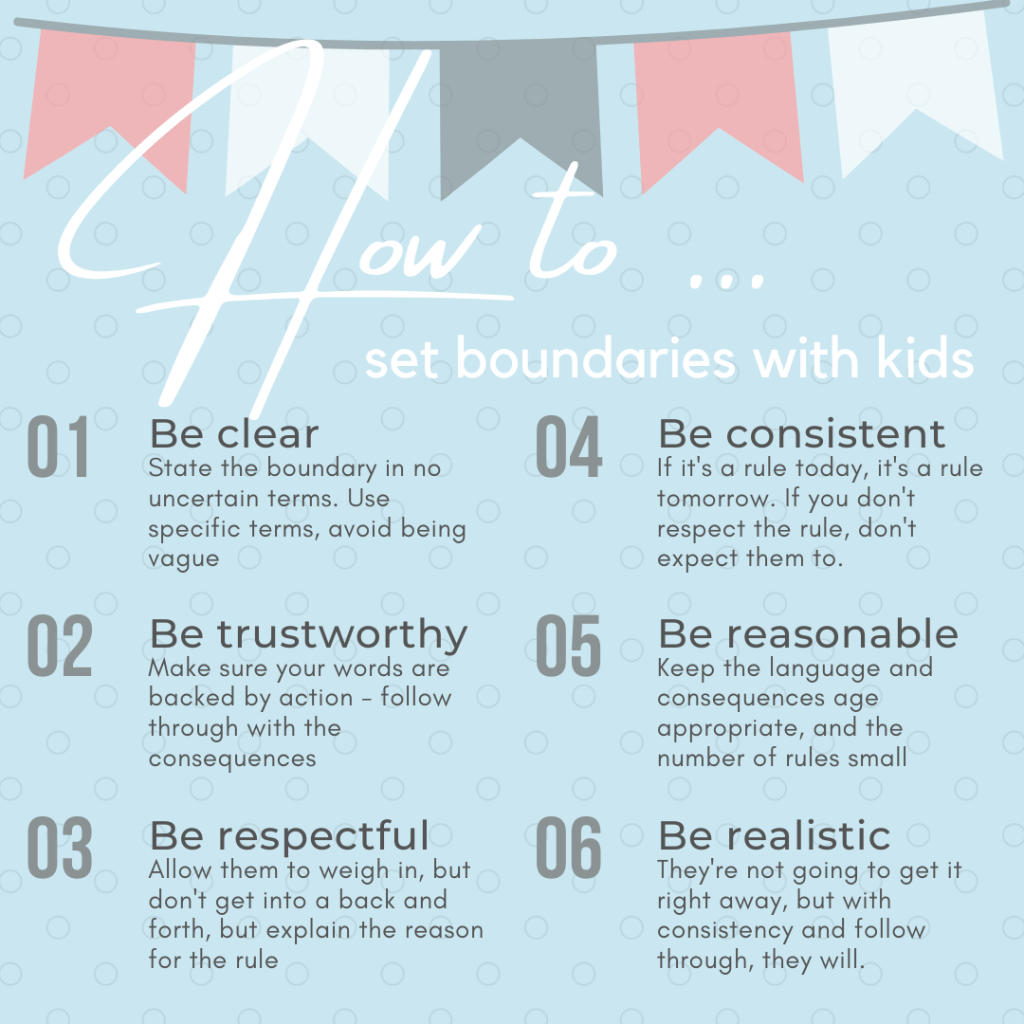
So, with the above guidelines in mind, how do we set boundaries respectfully?
- Be clear
State the boundary clearly and concisely and avoid using language that is vague or could be misinterpreted. For example, how much clearer is “I can’t let you hit” than “hands to yourself”? If we are unclear, we set our kids up to fail. If the boundary can be misinterpreted, we can’t hold them accountable in a fair and respectful manner.
- Be trustworthy
Children learn what they live. If you set a boundary but don’t follow through, how likely are they to recognize the boundary and stay on the right side of it in future? Another unintended consequence of not following through is that they learn not to trust what you say you are going to do. This can lead to an increase in future challenges because they can’t rely on you.
- Be respectful
Depending on your child’s age and their vocabulary, allow them to weigh in and problem-solve the boundary with you. If it is a boundary that they are not too happy about, or your child is seeking control, be aware that you may get into a back-and-forth discussion about the boundary. Allow them to voice their opinion, validate their thoughts and set the boundary. For example, if you are putting in place a boundary with regards to screen time, expect some pushback. Hear them out, and explain to them your reasoning behind the boundary and then stand by it.
- Be consistent
This goes hand in hand with being trustworthy. If we allow the transgression to slide one day, but not the next, it is easy to breed resentment and confusion within our children. Remember that they don’t have your experience and judgement to decide when it is and isn’t okay to break the rule. Think about it like speeding – we tend to speed because there is no consistent consequence for breaking the traffic rules. Generally, the consequence occurs every now and then, and this serves to make us feel more comfortable with breaking the boundary on the off-chance that we won’t get caught.
- Be reasonable
It is nearly impossible to follow a set of 500 rules, at any age. So much more when they are young. Keep your expectations within the age-appropriate parameters. For example, it might be okay for our two-year-old to be in the bathroom with you, but it certainly isn’t okay for your twelve-year-old. Keep their age and developmental stage in mind when setting boundaries, and keep the number of boundaries reasonable.
- Be realistic
Know that your child is not going to be 100% successful right off the bat, and that there is likely to be some upset when you follow through with the consequence for breaking the boundary. This is okay! As long as you stay confident in your decision, and allow that their response is okay and normal the next time will go better. And the time after that will go even better. Our kids, like us, are humans and are prone to making mistakes. When we accept this, and capitalize on the opportunity for learning something from that, the experience has been valuable.
What to do if they break a boundary?
And trust me, they will! Knowing how to respond to a broken boundary is just as important as having boundaries in the first place. In my experience, punishing a child for a broken boundary only serves to teach them how not to get caught the next time. Instead, there are two things I like to do:
The first is the incompatible opposite – tell them what they can do instead! If they continue with the behaviour that breaks the boundary, clearly and firmly state that you will need to remove the item or step between them and the item involved. For example, if your child is throwing toys you can offer the incompatible alternative “toys aren’t for throwing. You can throw your ball instead.” If the throwing continues, you can then step in – “Throwing toys might hurt someone. I can’t let you do that. I’m going to put the toys away.”
The second option is to allow them to experience the logical consequences of their actions – after all, the boundaries aren’t arbitrary. This option is only for boundaries that would not have significant deleterious effects for your child or anyone in the vicinity.
When you have an action plan, following the guidelines above, you will learn to trust and respect your child or teen’s intelligence and in return, you will gain their trust and respect. That’s a whole lot of payoff for a few day’s worth of work!
If you would like more positive parenting insights, these books are a mainstay on my desk (I use them too much to keep them on the shelf!)


Let me know in the comments what kind of boundaries you have set and how it went!


 ThinkerBlog