

Recently, in a Coffee with the Coach chat with parents in the ThinkerKid community, a mommy asked about screen time. During the lockdown period, where schools and outside activity ground to a halt in order to flatten the COVID-19 curve, many parents continued working while trying to manage without the assistance of childcare. Naturally, this has been an incredibly difficult situation to cope with, let alone manage and many parents slackened the rules around screen time. No judgement here – these are/were extraordinary circumstances and as far as I know, none of us were given a Parenting Through a Pandemic handbook. You gotta do what you gotta do.
But, as the world slowly returns to normal, this mom was concerned about her three-year old’s iPad use. They had taken great care to ensure that the games and activities on the iPad that are available were both age appropriate and educational. As they were able to get help after the most stringent restrictions were lifted, they were also able to decrease the amount of time their little girl spent on the iPad. As far as I can see, they had done the utmost to ensure that the screen time was reduced and well monitored. They were doing a great job!
Their concern, however, was this: Their beautiful baby girl had developed a habit of asking for the iPad as soon as her carer left for the day, and when the time came to then remove the iPad, her behaviour would change. She would refuse outright, whine, and at times even growl. Being respectful parents, they also felt badly about the idea that they would need to physically remove the iPad from her. They were at a loss, having tried to put the iPad out of view, only charging it for small amounts of time so that the battery would run out quickly and still had trouble with the behaviour that invariably followed. I had to take my hat off to these parents – they cared so much about what was right for their child and to be respectful towards her.
So how do we navigate a situation like this?
The first thing we discussed was to break down the situation to the core problems: giving up the iPad, reducing requests for the iPad
Children only really develop the ability to inhibit their responses after age 6, which meant that knowing when to stop playing with the iPad and willingly hand it back to mom and dad was very difficult for her. Just understanding that we are working from the viewpoint that she just didn’t have the skills to do this successfully, is already a step towards knowing how to support her. We discussed the following positive discipline tools to help her with this:
- Taking time for training by practicing giving up toys when asked. The goal for this family was to give their little girl a sense of control and capability by practicing how to hand over the toys, and eventually the screen when asked. Removing the iPad from her would be disrespectful, and would decrease her sense of control over her world. So, during calm times in the day, they would practice handing the iPad to each other.
- Changing the routines. Another concern for the family was that they had a newborn and both parents were working from home, which meant that it was easy to lose track of how much time their little girl was actually spending with the iPad. So, we discussed when the best time would be for her to have the iPad. Since the night time routine was fairly well established, I suggested that they only give her the iPad between two routine activities, such as between bath time and dinnertime. This would make it easier to keep track of how much time she spent with the iPad, and moving on to something else that was part of the routine would make sense to the little girl, rather than the iPad needing to go arbitrarily.
- Involving the little girl in the problem solving. Although she is only three years old, I suggested that mom and dad included her in the discussion about the iPad. Children are often more willing to participate in the solution, if they helped to create it. This reinforces the sense of control and capability while being respectful. They also had the freedom to veto a solution she suggested, but it did allow her to be heard. Being heard goes a long way in building a mutually respectful relationship.
These were the primary solutions that I asked the family to explore, and I am keen to hear how it went! In the meantime, here are some further tips for managing screen time at home:
- Values
(Children, Tweens and Teens): Before laying down some ground rules around screen time, talk to your children about their use of electronics. Listen with an open mind while talking about how they use their screen time, which content is and is not appropriate and why. Discuss with them the duration of screen time that you and they are comfortable with – again, it is your prerogative to set boundaries, but when children and teens agree with a boundary, or at least understand it, they will be less likely to push back. Invite them to discuss your family’s values around screen time. Talk about the content, the purpose and the goal of the screen time and guide them to come to their own conclusions about your values as a family. Be sure to talk about how and why this can differ from other families, and listen respectfully to their views as well. This invites cooperation, as they will feel that their opinions and thoughts have been heard and considered.
- Setting boundaries
(All ages) It is inevitable that you will have some push back when the time comes to put the screens away. Have a family meeting where you discuss the problem, and work together to brain storm a solution. Agree on the following: What the boundary is (for example, which days and times they can use the screen, and for how long); what you will do if they don’t stay within the boundaries. Collaborate to come up with a plan that is respectful and workable for your family. If you agree, for example, that when screen time is over you will turn off the wi-fi, you will know what to do when the time comes, and they will know to expect it.
- Kind, and firm
(All ages) A core principle in positive parenting is being kind AND firm. It is easy to vacillate between the two, and becomes confusing and frustrating for all involved. When holding a boundary, aim to be both kind and firm. Kindness can be confirmed through tone of voice. Set the boundary kindly (sweetheart, it’s time to put the screens away now), but hold the boundary firmly. Invariably, kids will have thoughts and feelings about having to put the screens away. It is okay to validate their feelings, for example “You feel sad/mad/annoyed that the iPad/TV/needs to go now. You wanted some more time” but hold that boundary. Letting the boundary go because they aren’t happy with it is disrespectful to your children’s well-being, but also to you. When holding the boundary kindly but firmly, it can sound like this “You’re annoyed. You want to keep watching. It’s 6 o’clock, the iPad needs to turn off now.” Importantly, say it only if you mean it, and if you mean it, do it.
Expect some challenges in the beginning – it takes time for children to learn to trust the boundary. Allow them the space to have and express their emotions when they meet the boundary, but keep the boundary. As they learn to trust that you mean what you say, and that you will follow through, their upset will decrease. Don’t try to talk them out of their feelings, or distract them. Validate their feelings, and then stop talking.
Some more helpful hints for no-drama screen time:
Model: Show your children that you are honoring the boundary by putting away your phone or screen as well. Children see better than what they hear, and they will follow your lead.
Small steps: If there haven’t been any boundaries around screen time, an all or nothing approach is unlikely to be successful. You can start small by limiting screen time at certain times of the day, or during certain days of the week. Gradually change their habits.
Alternatives: For many young children, screens are highly rewarding and engaging. Reducing screen time can often leave them wondering what else to do. Make sure you have alternative activities that are fun and rewarding available.
Special time: Your undivided attention is invaluable to your children. Make sure to have time set aside each day to spend with them, without demands placed on them. You will soon find that they find this far more rewarding than screen time!
On my bookshelf:
These books have been invaluable to learning how to discipline respectfully and guide little ones in their development:


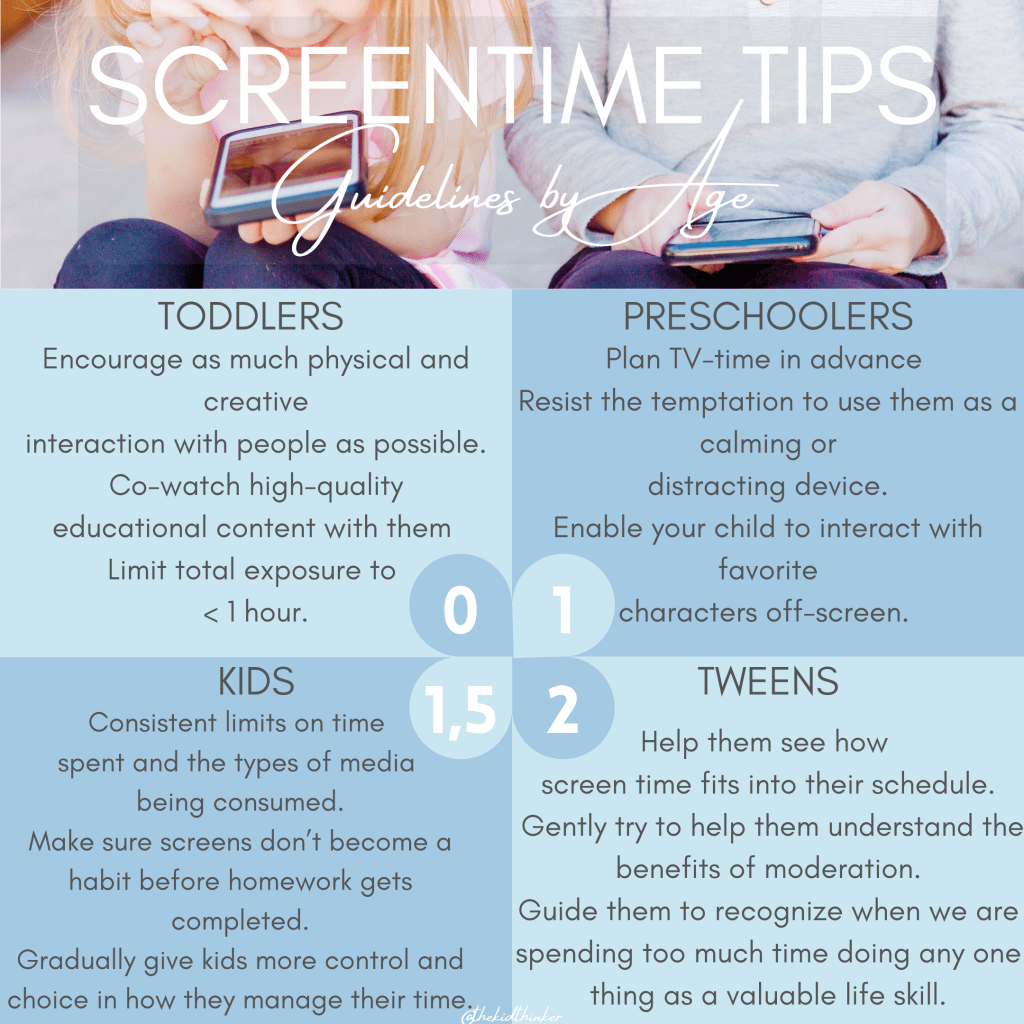
General guidelines for screen time (as recommended by the World Health Organization and the American Academy of Pediatrics:


 ThinkerBlog