
I recently received this question on the ThinkerKid Positive Parenting Group:How do you teach your little one that there [are] bad people out there that can do bad things to us without 1. [Stealing] their innocence and 2. Cause them to mistrust everyone?I loved this question for many reasons, not least of which the concern for keeping our little ones safe, without causing them fear. Here are my thoughts on keeping children safe:
Teach children about their “safe” people:
Children have an instinctual awareness of when people are familiar and when they are strangers – we see this in their natural development at around 6 to 8 months when they are no longer happy to be held by just anyone, peaking at around 12 months and starting up again at the age of 2 years. As they gain confidence through guidance and validation, they may gravitate towards unfamiliar people again – this is okay! As positive parents, we can build on this natural instinct by firstly teaching our little ones about their safe people – while keeping in mind that inappropriate interactions are perpetrated by familiar people 93% of the time.
In general, we have levels of relationships:
- The inner circle: me, mom/dad, doctor
- Close friends and family
- Family, friends and acquaintances
- Strangers
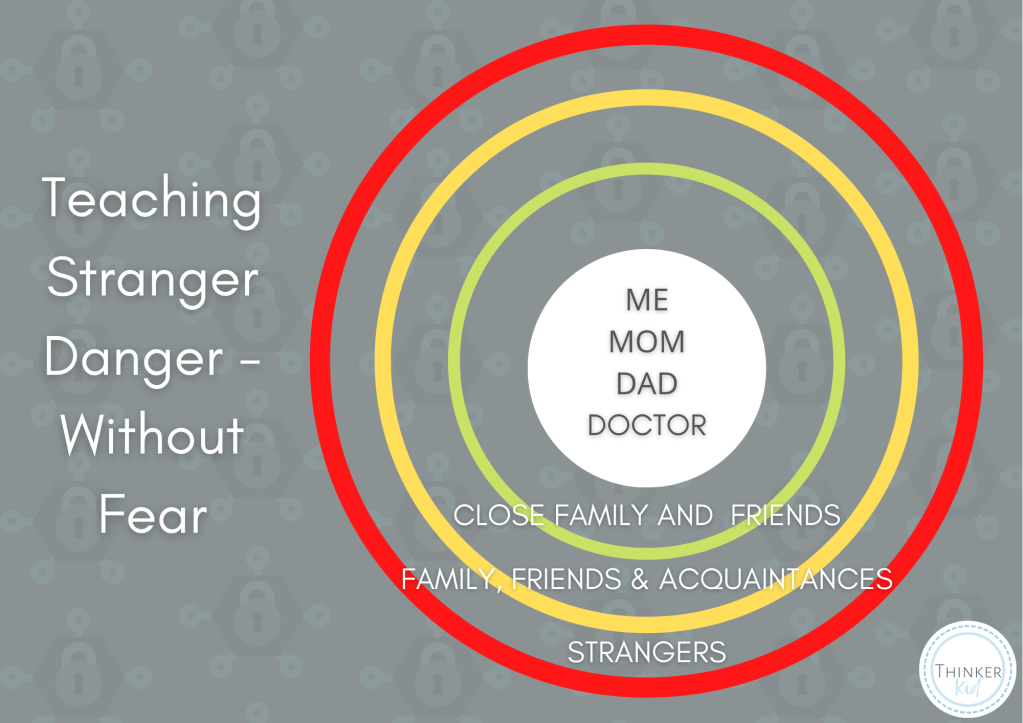
When children can visualize how close people are to them, and can identify what is and is not appropriate to do with them, they already have several skills to keep them safe!
You can recreate the visual above and talk about who would fall in each circle and what may or may not be appropriate to do with each of them. Then, practice! Role play with your little one what they would do or say if a situation happens.
Teach children about consent:
This is the most important skill to teach your little one in order to keep them safe. Teaching children to recognize when they feel comfortable, versus when they feel uncomfortable, and reassuring them that you will always listen to and respect their feelings will help them to learn that they get the first and last say about who touches them, and how.
This is especially important, since the overwhelming majority of abuse cases are perpetrated by those who are familiar to they child. It is important that our kids understand that regardless of their relationship to the person, they are allowed to give and take consent
What consent is:
In essence, consent is about boundaries – what they are okay with, and what they are not okay with. They are the boss of their own body.
I like the following rules, but you can add or change them according to what works with your family and values:
- Touches that keep me clean and healthy are okay
- Mom/dad and my doctor are people who help me to stay clean and healthy
- My body is mine, and I get to say who is allowed to touch me
- I am allowed to say “no” if someone wants to touch me anywhere
- I can say “no,” even if I said “yes” before
- My safe people can help me undress with my permission
- I can say “no” if I don’t want to be in a photo
Children understand the word “permission” – they have to ask permission to do things, borrow things, play with things, so this is a great word to use. Teach them that if someone asks to do something that they are not comfortable with, they are allowed to say “no.” They are also allowed to take away permission at any time – for example, in the middle of a tickle fight, if they say “stop.”
Put it into practice:
- At home with hugs, kisses or tickles – ask permission and respect it if they say “no.” You can practice this during roughhousing, pretend play or even setting up explicit opportunities to practice. It is essential that children have opportunities to practice giving and taking consent in safe spaces so that when it really matters, they are comfortable to say “no”
- Practice saying “no” for the same and having them respect your boundary – children are naturally curious, especially around age 4 when they start realizing that not everyone’s bodies look the same. Teach them to respect your physical boundaries by giving them opportunity to stop when they are told “no” – you can work this into the scenarios above as well.
- The same goes for dressing or photography – if your little one is not comfortable or happy about taking off their clothes or being in a photo – respect their “no”
- Allow them to refuse greeting friends and family with hugs or kisses – if the friend or family member tries to force it, speak up! Your child will appreciate you backing up their decision. This reinforces the idea that children are allowed to say no to adults, especially when it comes to their bodies. Without your backing, children might be too afraid to protect their boundaries, especially with friends and family members. Keep in mind that forcing a child to hug or kiss sends the message that adults have power over their bodies – this sets them up to be vulnerable to predation.
Naturally, there is so much more that can be said about this topic and the guidelines above are just that – guidelines. If you are concerned about your child, contact the Teddy Bear Clinic at 011 484 4554 or http://ttbc.org.za/

 ThinkerBlog