

When we think about manners, we often think about our child in context – that is, in the context of social interactions where their characters will be judged and evaluated based on their manners. Phew, that’s a lot of pressure to put on yourself and your little one.
While manners definitely do impact how our little ones are viewed by others, what about the flip side? How can teaching our children good manners impact how they view themselves?
While we all want our children to be viewed as “lovely” and “a joy to be around”, this should not be our end-goal when teaching manners. Remember that we don’t want to raise “nice” kids – we want to raise kind ones.
It is easy to fall into the trap of thinking that in order to teach kids manners, we need to emphasize how a lack of manners can have a negative impact on how others perceive them, and, while this is true, this should not be the motivation for teaching (and having) good manners.
How do we get there?
- Inside Out
Manners are all about being kind – not necessarily nice. When I say kind, I mean someone who is able to consider the feelings of others, without letting others’ opinions of them cloud their self-perception. It’s about respecting themselves first and communicating the same to others through their words and actions.
In essence, manners are best learned using an inside-out approach, rather than an outside-in approach. If we emphasize that manners are about having self-respect first, our children learn that manners are at the core of behaving in a way that is in line with who they are at their core, rather than emphasizing that they have to behave in a certain way in order to be acceptable to others. It’s not about manipulating others’ perceptions of them, the way an outside-in approach can lead us to believe.
The message our kids receive is then “I have good manners, because I am a kind person” rather than “I have good manners because I am scared that I will be judged negatively by others.” That’s quite a big difference.
- Appreciate that our behavior is an outward reflection of our inner beliefs about ourselves
When we believe that we are good people, and that we are worthy of respect, we will act in a way that echoes these beliefs. Look again at the message “I have good manners, because I am a kind person.” The message is NOT “I am kind, because I have good manners” – this is the core of manners being an outward reflection of an inner state. If we flip the message, “I am good person, because I have good manners,” we emphasize that our children are good only insofar as they are judged to be good.
Think about it like this: When I respect myself, I can respect others regardless of who they are. This respect for others is thus a reflection of my respect for myself. I am not using superficial respect for others as a way to gain respect for myself – this is sure to leave me disappointed.
So, again, how do we get there? When praising, praise the deed, not the child. When we focus on the deed, rather than the doer, our little ones learn that they are unconditionally accepted. When children feel unconditionally accepted, valued, and loved they do not revert to “survival” behaviors to get these fundamental needs met. They do not have to engage in behaviors (good or bad) in order to be acceptable to others. This creates an environment in which they can learn manners as a reflection of their inner state.
When children are in “survival” mode, their behavior will reflect this – and we can pick up on those symptoms and address them by helping them get their needs met. When we make their lovability, worthiness, and acceptability contingent on their behavior, they learn to mask symptoms of mental distress through pleasing (i.e. good manners), which makes it harder for us, as their parents, to see what is going on until they EXPLODE.
- Be realistic
Now, I know we all want impeccably mannered children right off the bat, but it is important to have realistic expectations in terms of our little ones’ developmental level and age. When we keep this in mind, we are able to manage our expectations and teach manners in a way that is deeply respectful to our children and where they are at. This makes it MUCH easier for them to learn because guess what? Their brains are developed sufficiently to actually learn AND use the skill!
Below are some guidelines of what to teach, and when (these guidelines were taken from familyeducation.com (read the full article here ):
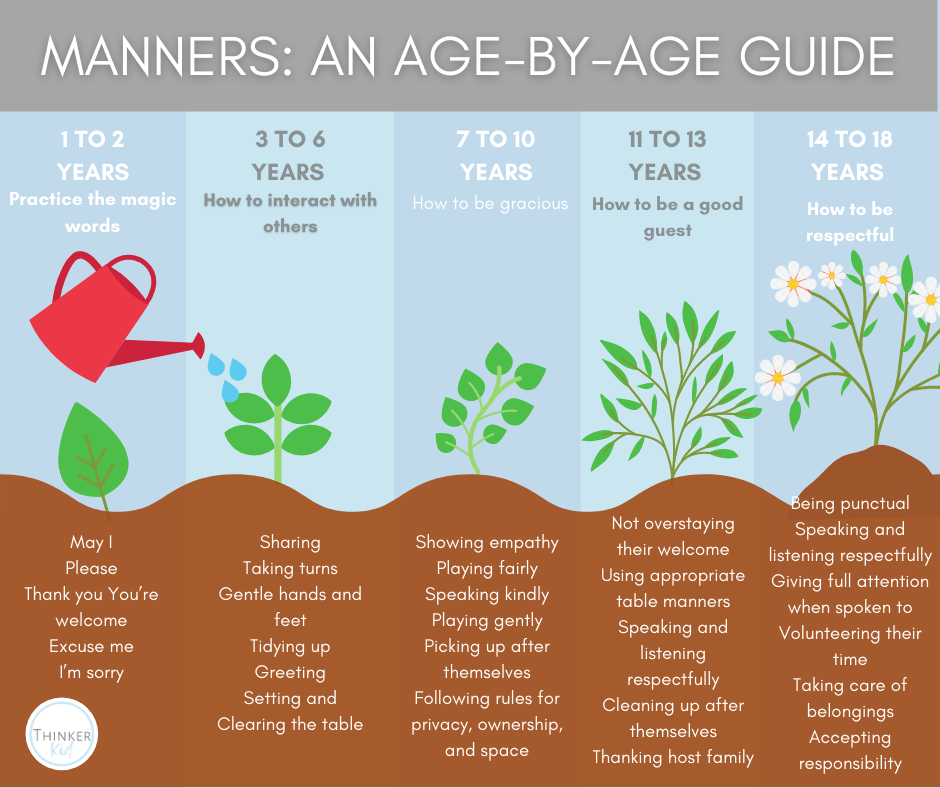
- 1 to 2 years old: Practice the magic words
- Getting children to sit still for long at this age can be difficult. Be patient, and practice with your toddler the “magic words,” such as:
- May I
- Please
- Thank you
- You’re welcome
- Excuse me
- I’m sorry
- 3 to 6 years old: Teach how to interact with other people
- Sharing his toys, taking turns, and playing fair with other children.
- Keeping his hands to himself and never hitting or name-calling.
- Picking up toys, books, and dirty clothes. Use this printable on clean-up time to help him learn.
- Helping set and clear the table (of anything child-friendly) at mealtimes.
- Saying good-bye and thank-you when leaving a friend’s house or party.
- 7 to 10 years old: Teach how to be gracious
- By this age, your child should have a fairly good sense of right and wrong. Now is the time to teach your child empathy and gratefulness for what he or she has, and for what others do that benefit him or her.
- Sharing his toys, taking turns, and playing fair with other children.
- Keeping his hands to himself and never hitting or name-calling.
- Picking up toys, books, and dirty clothes. Use this printable on clean-up time to help him learn.
- Go over rules for privacy, ownership, and space in your household. Tell your child she always needs to ask permission before touching or taking things from family members and friends.
- As a family, make or decorate door signs or doorknob hangers for everyone’s bedroom to show that it’s their own space. Ask your children to knock before entering if a door is closed.
- 11 to 13 years old: Teach how to be a good guest
- Don’t overstay his welcome. Talk with the host parent about when he should come home.
- Use his best table manners.
- Speak and listen respectfully, making eye contact and not rolling his eyes. Don’t tolerate swearing or other rude behavior.
- Clean up after himself and thank the host family before leaving.
14 to 18 years old: Teach how to be respectful
Teenagers sometimes get a bad rap and earn a reputation – whether founded or not – of showing disrespect toward adults. Do not allow your child to get away with rude behavior toward you or any other adult, under any circumstance.
- Listen to your teen and expect her to listen to you in return. Mutual respect is more important than ever during your child’s teen years.
- Tell her that being on time for appointments and other plans is a sign of respect, so don’t be late.
- Encourage her to help older people when they need a hand. Volunteering is a great way to practice good manners and interacting with different kinds of people.
- Give your teen time for privacy and using new media, like cell phones and music players. But ask for her full attention when you’re talking or eating with her. Most teens are obsessed with media, so setting rules for appropriate use will help her learn good etiquette.
Be proactive, be be proactive!
Don’t wait to teach manners when your child has already made a faux pas – this is likely to invite them to become defensive and not hear the lesson. Make it a point to talk about, demonstrate and practice manners. Here are some ways you can achieve this while focusing on empowering and respecting your child:
Family Meeting:
Talk about the whys and wherefores of having good manners, what good manners look like and when they should be used.
- Keep it brief
- Explain why a particular manner is important
- Outline the expectation
- Talk about the social consequences, but emphasize self-respect and respect for others
Lead by example
Unless we set the example, it is not reasonable to expect them to have good manners. When we model good manners consistently, our children develop a template of what these manners look like in action, without necessarily feeling pressured to do the same.
- Kids see better than they hear, so no matter how much you talk about it, unless they have a template, it’s not going to happen
- Remember to mind your manners with them, specifically
- Avoid pointing out when you are using good manners – instead of getting the message, “I would like for you to do the same,” they get the message “Mom is a good person because she has manners”
Time for teaching – but make it fun!
Play is the best way to teach a new skill – research has shown that children absorb and practice new information when they are allowed to enact in through play. Here are some ideas to make teaching manners fun:Catch me if you can!
- Develop secret signals
- Read stories and talk about them
- Exaggerate it one evening during dinner
Role-play
When there is a particular manner you would like to focus on (and let’s be honest, we all learn better in small increments), you can do this through role playing and feedback during imaginative play:
- You can do this with toys (even cars and dinosaurs can use some manners!)
- Change it up – make it a game by following these steps
- Ask questions about the do’s and don’ts
- Practice, “catch me if you can” – see if your little one can spot when you make a mistake
- Your turn! You practice
- Feedback (as the character) – respond how the child would receive feedback in the natural environment, but keep it constructive
- Change it up – make it a game by following these steps
Make a fuss (when they do the right thing!)
Depending on the child, this can be a small acknowledgement – respond effusively, with some physical affection if they like it
References:

 ThinkerBlog